Economic development that includes everyone.
Place & Community
Communities across Australia are already doing the hard work of tackling entrenched disadvantage. Work is ongoing in areas like working on housing, health, food security, children and youth, education, justice and employment.
What's missing, almost everywhere, is the coordination across all of it. Good initiatives run in isolation, each tackling one part of the problem, and none of them add up to a local economy that works for everyone living in it.
That's what Global Sisters' Place & Community approach adds. We bring an inclusive economic development lens and facilitate local collective impact work: getting council, business, philanthropy and community organisations around the same table, working to shared goals instead of separately. That's how communities grow an economy that includes the people most often left out of it.
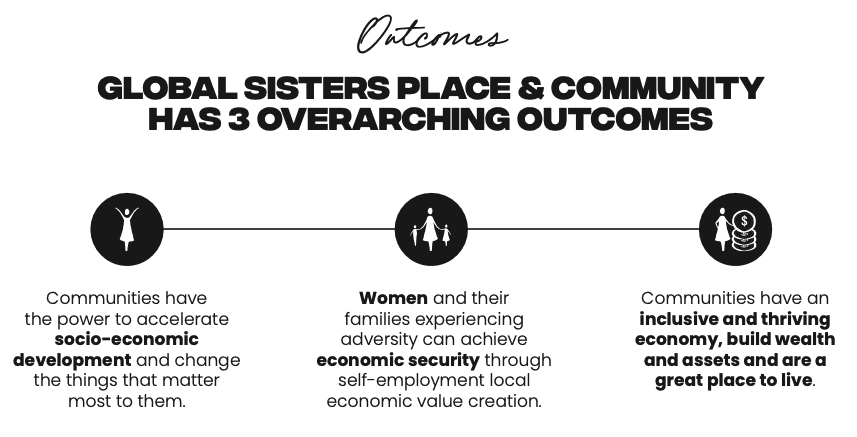
A stronger, more inclusive local economy isn't the end goal on its own. It's the lever. More people earning, more local businesses trading, more money circulating locally, and health, food security, housing, education and justice outcomes improve with it. Economic security is foundational to almost everything else a community is trying to fix.
WHY THIS MATTERS TO US
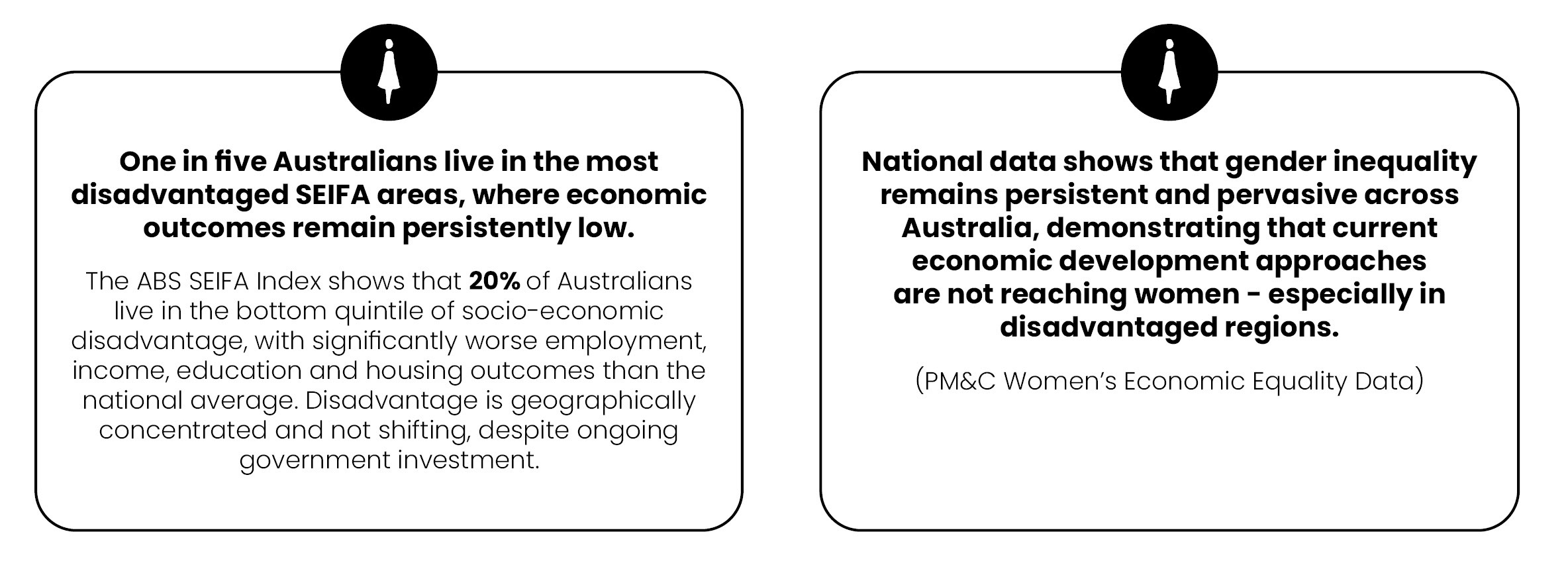
One in five Australians live in the country's most disadvantaged areas, and that hasn't changed in a generation, despite the funding that's been directed to some of these communities. Most economic development strategies respond with a jobs focus and support for large employing businesses. Place-based programs respond with an early-years, children and youth focus. Both are worth doing, but neither are genuinely inclusive or shift the dial on disadvantage for the entire community.
Three things get missed almost everywhere - in local council economic development strategies and local place-based work:
- Inclusive economies: Self-employment and micro-enterprise. Micro businesses make up 92% of all Australian businesses and 89% of all employment, by headcount, but they're invisible in local employment and economic strategies and lumped into "SMEs" which operate completely differently and need different supports.
- Women. Especially solo mums, older women, migrant and First Nations women, those with disabilities and women in regional areas. Business and self-employment support in Australia is built for metro start-ups chasing venture capital, and it skips straight past women.
- Cross sector contribution and coordination, and systems change. Typically we see the work falling disproportionately on the community and non-profit sector. In order to create systems change, we have to bring in all sectors where the change needs to happen. Government, philanthropy and business need to be part of the solution from the start.
Global Sisters addresses these gaps through a genuinely locally-led collective impact model. Women's economic security is treated as a core economic development strategy, on equal footing with any other lever a community pulls to build its whole economy and improve community wellbeing for all.
WHY THIS SHOULD MATTER TO YOU
Most place-based work in Australia is aimed at children, early years and education. That's not a criticism, it's necessary work, and some of the country's best-run collective impact sites have built real results doing exactly that. But a childhood-focused lens can only ever address part of a whole-of-community problem.
Fixing disadvantage in a place takes more than one lens. It takes every part of the community pulling in the same direction, council, business, philanthropy, services, and the people living there, working from a shared set of goals instead of parallel, separate ones. That's the whole premise of collective impact, and it's why it works.
We bring the women's economic security lens. We have a proven framework that has meant over 10,000 women have started their own micro business in the last 10 years, and are now making real in-roads to changing the government and private sector systems that are preventing women's economic security. A cross-sector collective approach, with common goals, will drive results for whatever your community decides is most important, whether that's housing, youth engagement, local employment, or something else entirely. A stronger local economy, with more women earning and spending in it, lifts the whole place. That's the case for joining, or building, a Collective Impact Group where you are.
Community organisations and non-profits
What you're already doing counts. Joining a Place doesn't mean doing more, it means connecting what you already do to a shared set of goals, and sharing in the evidence of what's changing. That's a stronger story for your community, and a stronger case to take to funders.
Philanthropy and Investors
A stronger local economy doesn't just help the cohort you're funding directly, it lifts the whole community around it. We're building the long-term funding infrastructure to back that at scale, and looking for founding partners who want to help design it, not just fund it once it's built.
Government (including Council)
This is economic development. It belongs in your strategy, not next to it. We're looking for partnerships that put women's economic security into local, state and federal frameworks for self-employment and community investment.
Business and the Private Sector
Every woman in business in the community has access to "everyday spend" from corporates via the Back Her Brilliance platform. Coaching, pro bono support and local investment all have a direct line to women building real income in your community, and to the flow-on effect that has locally. Find out more here
Community organisations and non-profits
Self-employment is a viable pathway for people which is under-recognised by the current system. We're already working at a federal level, advocating for welfare and employment settings that support self-employment, not treat it as outside the system. Our work brings local infrastructure, business coaching, financial pathways and peer support that can sit alongside employment services and open up outcomes job-matching alone won't reach.
WHAT A PLACE PARTNERSHIP LOOKS LIKE
We facilitate or convene but the community owns and leads it.
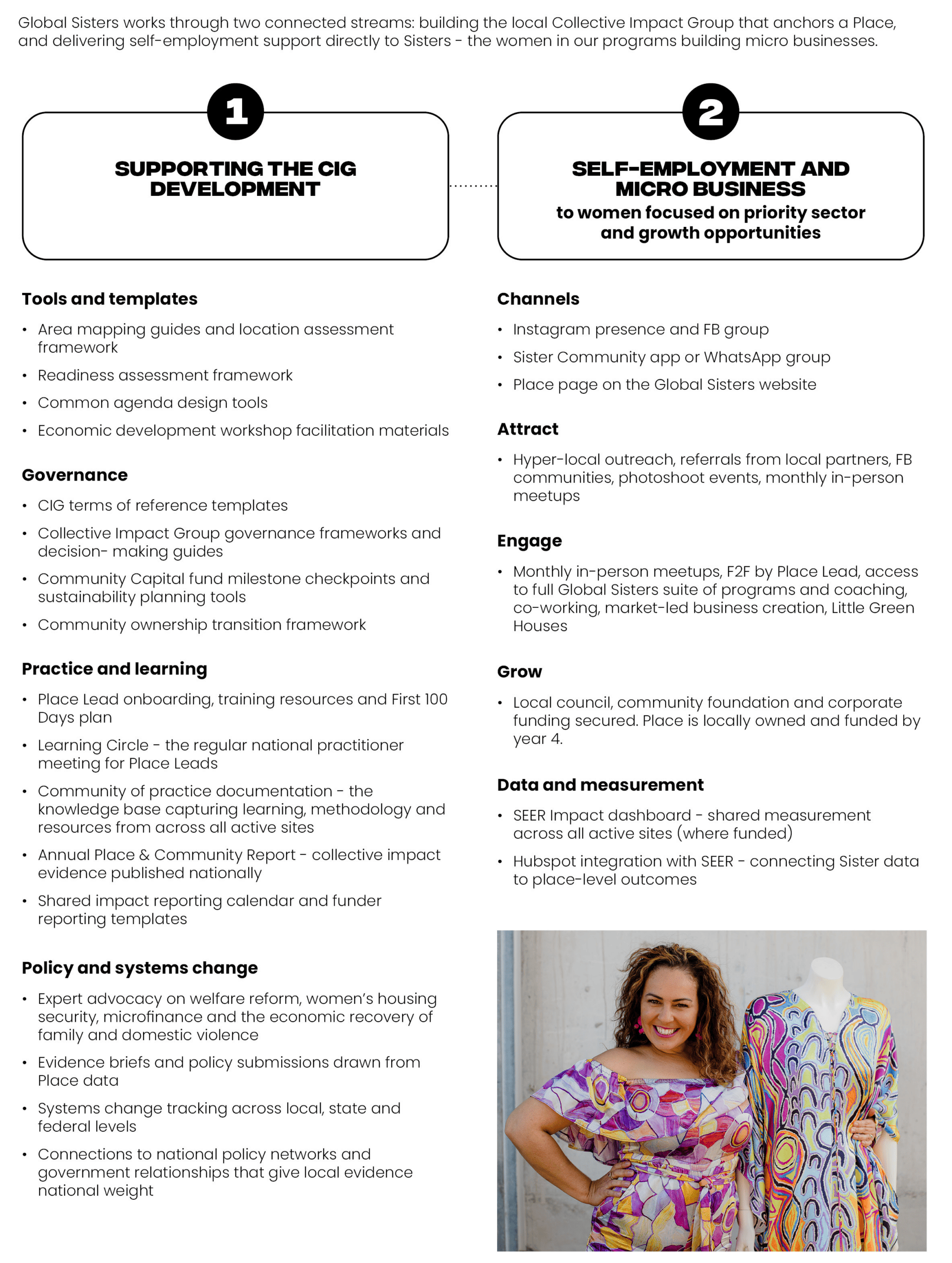
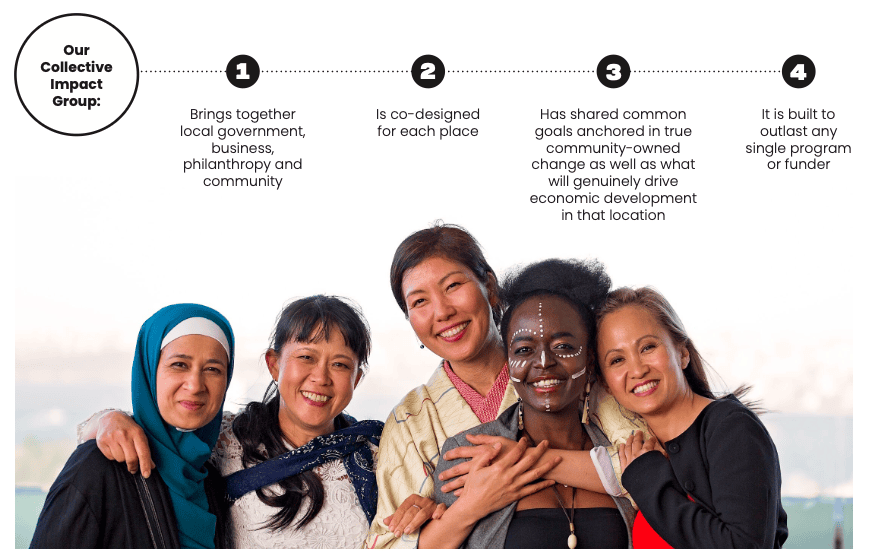
Global Sisters doesn't run Place & Community work alone, and we don't lead it forever. We facilitate a local Collective Impact Group, bringing council, business, philanthropy, non-profits and community together around a shared agenda.
Every organisation keeps doing what it does best. Nobody's asked to work outside their mission. Our lane is women's pathways into self-employment: business coaching, financial literacy, peer connection through the Sisters community, and the systems change work that backs it up. Local partners do the same- they stay in their expert lane and keep doing what they have been doing. The difference is that its integrated, coordinated and all pulling towards the same goals.
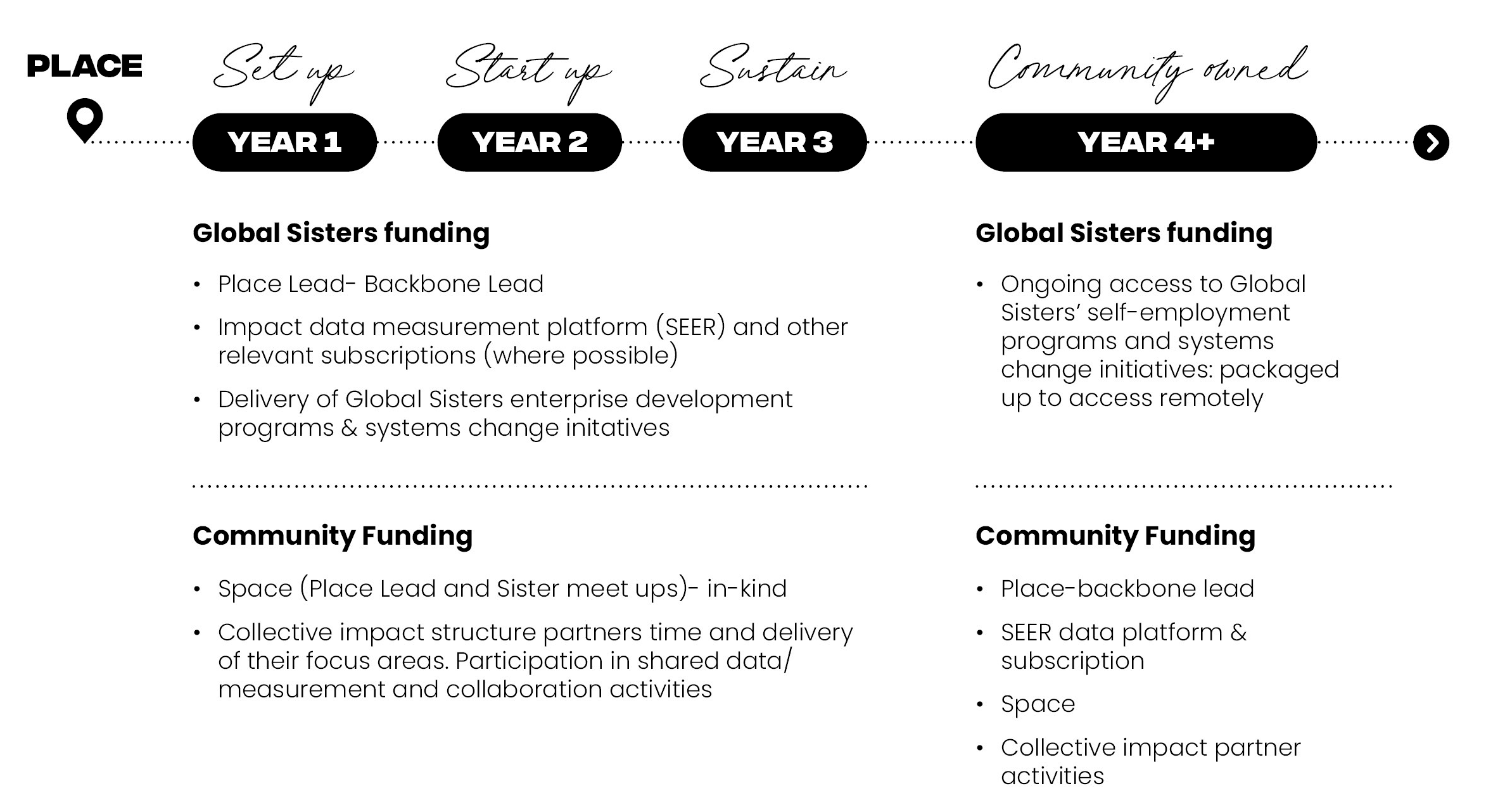
We fund a Place Lead on the ground for three years, who is responsible for convening the Collective Impact Group and delivering the Global Sisters stream of work. From year four, the community owns it, governs it and funds it. Global Sisters keeps delivering programs and support , but the local infrastructure is built to stand without us.
What makes this different:
- Inclusive economic development, not a jobs program or early childhood focus
- Community wealth building and local asset ownership
- Systems change work running alongside local delivery
- Bringing together all sectors to contribute their expertise and resources to achieve a common goal.
THE PATHWAY:
FROM SET-UP TO COMMUNITY-OWNED
Every Place moves through the same four phases. What gets built inside them is entirely up to the community.
Global Sisters is building toward 30 Place sites across Australia over time. Two are active now, Norlane/Corio in Northern Geelong and Armidale in NSW, with more communities joining over the coming years.
IS YOUR COMMUNITY A FIT?
It’s really important to us
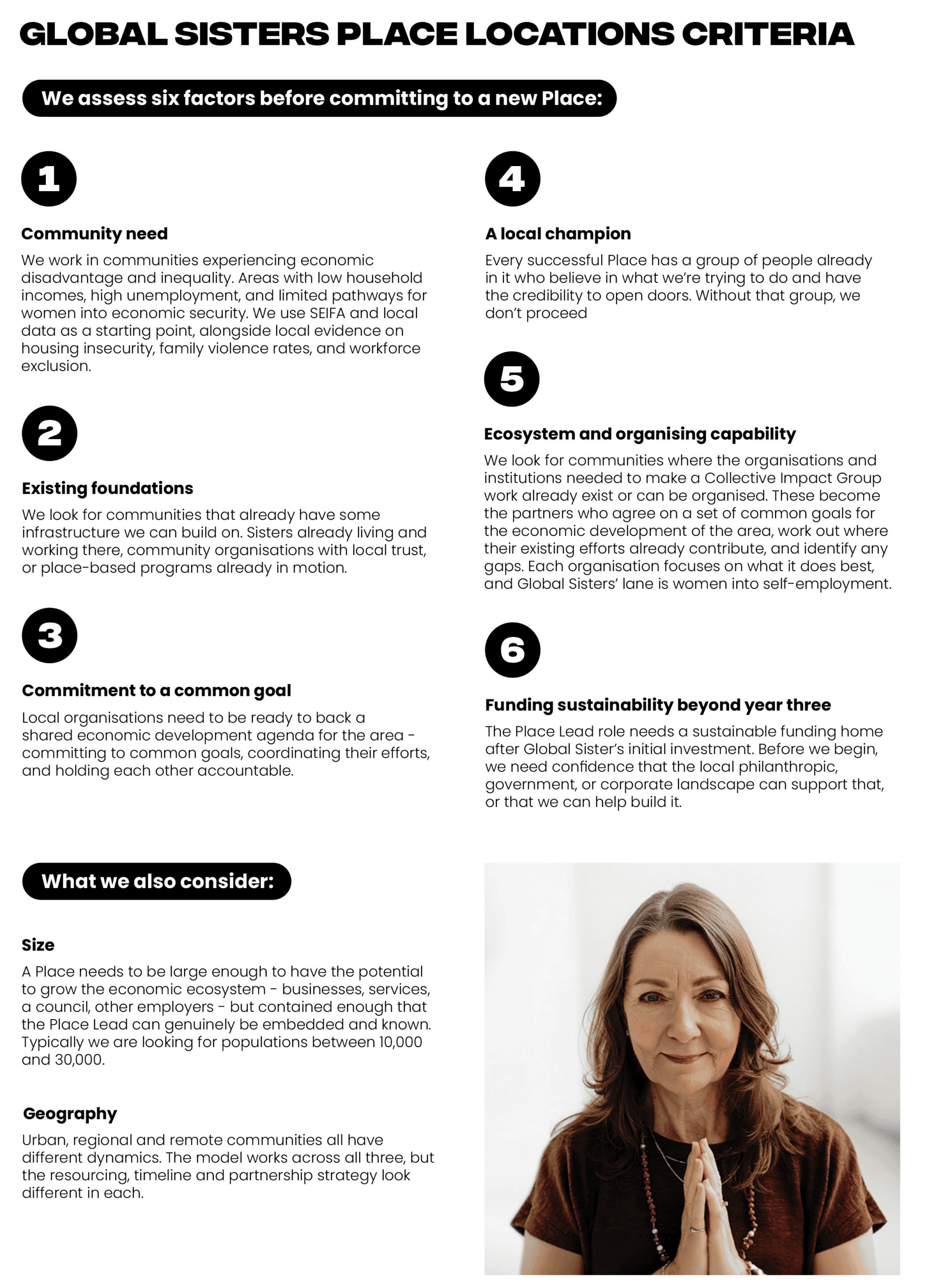
- Real economic need. Entrenched disadvantage, low household incomes, limited pathways for women into economic security.
- Something to build on. Sisters already living and working there, trusted local organisations, or place-based work already underway.
- A shared vision for a community that people will commit to. Local organisations ready to back one economic development agenda and hold each other to it.
- Local champions and organising capacity. The partners a Collective Impact Group needs already exist, or can be brought to the table.
- Population matters too, we're usually looking at 10,000 to 30,000 people: big enough to grow an economy, small enough for a local Place Lead to genuinely know it.
Ask yourself: Is there a group in your community ready to back a shared economic vision? Is there a gap between the jobs and services on offer and what women there actually need to get to economic security? That's where this conversation starts.
How it works
- Get in touch. Tell us about your community.
- Place Readiness Session. An online briefing on how the model works and what's involved.
- Readiness assessment. A collective submission, coordinated by your local champion and the organisations who'd form your Collective Impact Group. It sets out the local need, who's already working on it, a potential Place Lead, and how that role could be funded past year three.
- Place Conversations roadshow. We visit shortlisted communities and hear directly from the people who'd make it work.
- Initial Place agreement.
- Download our Delivery Model here